
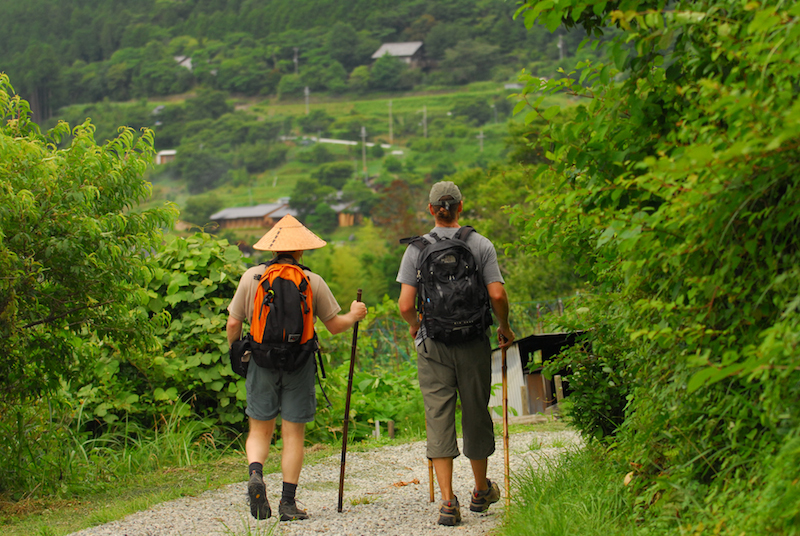
Adapted from an article by Chris Kavanagh, RAW Travel, originally published on rawtravel.com.
By Chris Kavanagh, RAW Travel
If you've completed the Camino de Santiago (or a section of it) across northern Spain there's a good chance you will want to walk the Kumano Kodo on Japan's Kii Peninsula, or vice versa. We often get asked about the similarities and differences of these two iconic walks, so here are a few facts and insights.
UNESCO World Heritage listed
There are only two pilgrimage routes on the prestigious UNESCO World Heritage list: the Kumano Kodo (listed in 2004) and the Camino de Santiago (listed in 1993). Known as the pilgrimages of the rising sun in the East and the setting sun in the West, both trails have been twinned since 2014.
Ancient, sacred pilgrimage trails
The Camino is an important Christian pilgrimage route, while the Kumano Kodo is a significant part of the Japanese Shinto-Buddhist tradition. Pilgrims have been following the journey to Kumano for over 1000 years. Both walks are culturally and spiritually important, beloved by many, and commonly described as "life defining".
Dual pilgrim program
If you walk both the Camino de Santiago and the Kumano Kodo, your efforts are honoured by the "Dual Pilgrim" program. You can get a dual pilgrim passport stamped along both trails and, on completion, receive a certificate of gratitude and congratulations – a great memento of an incredible journey.
Distance
The full Camino route is a whopping 790km. The Nakahechi Route on the Kumano Kodo is much shorter (68km), but still offers splendid walking through a mountainous and sparsely populated part of Japan. The full Camino can take 50 days; the Kumano can be completed in a 7-day itinerary.
Physical difficulty and terrain
The Kumano Kodo is a mountain trek with waterfalls and shrines, and is physically more demanding than the Camino. Set mostly in deep forest, there are steep ascents and descents each day, and underfoot you'll find exposed tree roots, loose rocks and stone steps, which can be very slippery. It can easily take 7 or 8 hours to walk as little as 14km a day. We highly recommend walking poles. The Camino, by contrast, is mostly rural farmland – not particularly strenuous, but you'll need endurance.
Directions and signs
You don't need maps or navigation skills on either trail – it's nearly impossible to get lost. The Camino is well marked with boundary stones, scallop shells and yellow arrows. Much of the Kumano is extremely well marked with wooden "Kumano Kodo" signs – there are even "Not Kumano Kodo" signs at some crossroads, and waymarkers every 500m.
Best time to visit
For the Camino, the best months are May and September. For the Kumano Kodo, you can't beat the spring cherry blossoms in March and April or the glorious autumn colours in October and November.
Crowds
The Camino is popular – more than 250,000 pilgrims reach Santiago each year – so it's very social. The Kumano Kodo is far quieter; on some days you may hardly see another walker, which makes for a more contemplative, solitary experience.
Accommodation and food
On the Camino you'll stay in albergues and pensions; on the Kumano Kodo you'll stay in family-run ryokans and minshuku, sleeping on futons in tatami rooms and enjoying elaborate multi-course Japanese meals – plus a hot onsen bath at the end of most days. It's a level of hospitality and comfort that surprises many Camino veterans.
Which should you walk?
Both! If you've loved one, you will almost certainly love the other. The Camino offers camaraderie and vast European landscapes; the Kumano Kodo offers ancient forest, sacred shrines and deep cultural immersion. And when you've done both, don't forget to claim your Dual Pilgrim certificate.